
LANDSCAPING SLOPES, HILLS, & EMBANKMENTS
Residential lots prepared for new construction in urban and rural areas quite often have large slopes in one or all side of the property. This has gone on for many years especially in hilly terrain of western states. New homeowners are left with the necessary task of stabilizing slopes after grading and new home construction is completed. If you have a home with sloping areas in front, side, or back yards you may view it as unusable property and a maintenance nightmare, or an opportunity to build a viewing deck and patio. Whatever you plan on doing you should be informed on the many faces of slopes.
Slopes range from gentle natural profiles with existing vegetation to steep slippery slopes of poor soil quality. These slopes are often graded and cut to provide level ground for new home construction. Steep slopes graded for new home construction cuts through several layers of soil, known as horizons, which leaves little or no topsoil or vegetation. In cases of new home construction builder installed landscaping on slopes is often designed to satisfy the local City and County Government requirements. This type of work represents a negotiation between builder and local government to provide a "minimum" amount of landscaping. Most often this consists of a spattering of common plants or ground cover (planted or hydro-seeded in place). Where large slopes exist an irrigation system is installed. This landscaping does not provide a permanent solution for the new homeowner and often fails within a short period of time.
There are various methods and techniques as well as new materials being developed and employed to stabilize and beautify slopes. Slopes must remain stable over a long period of time. A good slope design takes into consideration the physical aspects of the slopes such as height, width, and the aspect (direction the sun shines on its face). This also include the important issues of soil and soil erosion which helps in determining the irrigation and drainage that will be needed. Poor design, planning, and maintenance is often responsible for planting failures and excessive soil erosion which leads to slope failure.
DRAINAGE & EROSION
When left unchecked, erosion clogs drainage channels, rivers, and dams as it slowly makes its way downstream. Eroded soil from private property ends up in public streets and sewers costing public service agencies many millions in tax dollars to clean up. Soil erosion is dynamic and complex in nature. A nuisance to most homeowners, it is not often thought of as a worldwide problem. It is a far reaching socioeconomic problem, systemic in nature, whose impact is felt hardest in agriculturally based developing nations.
To the private homeowner, drainage and erosion control is a much to understand than it is to prevent. Soil erosion on residential properties is common after development and construction in spite of all the preventive measures employed during construction. During continual rainfall soil is carried in small granular form within water runoff. These fine granules are eventually deposited in streets and gutters through drainage systems from one property to a neighboring property. Some soils are more prone to erosion than others especially in regions of high annual rainfall or in areas that receive heavy rainfall amounts in short periods of time. If allowed to continue unchecked small amounts of erosion become excessive over time. As it increases in velocity water carves out channels and exposes more soil to erosion. Long periods of steady rainfall can saturate a slope making it unstable and causing earth movement or slope failure. Soil saturation and erosion fluctuates by the season. If your property is in this condition it requires heavy equipment and an experienced excavator to move soil back into place and properly grade.
Drainage systems on slopes intercept water traveling downhill during and after rainfall. They include engineered concrete v-ditches, culverts, retainer wall drains and underground pipe systems often used in residential projects. Culverts and v-ditches are engineered fixtures often found at the top, midway, and at the bottom of slopes. Placement is based on factors such as annual rainfall, soil type, and slope configuration. The expected runoff volume is calculated and the fixture is built to that specification. Residential properties are sometimes required to have drainage systems in place on slopes located behind private homes and in common land. This effort is a way to control storm water runoff and soil erosion throughout the development. These drainage channels must be maintained clean by the homeowner and free flowing. Several techniques aid in reducing soil erosion.
Sand bags and straw filled wattles often called 'snake bags' are temporary moveable fixtures that work well to divert water and reduce the amount of soil transferred in water by erosion. These are low cost materials used during new home construction and landscape projects. Straw wattles can be left in place for an extended period of time until construction is done and plants have grown.
Hydro-spraying applies a specially formulated natural fiber mixture to soil that is environmentally safe and dries firm to the touch forming a shell that protects soil. The solution contains tackifiers which adhere to the slope face. This treatment is a quick and temporary solution especially useful when applied prior to periods of expected rainfall.
Geo-textiles applied to the slope face and held in place with "staples" provide stability especially when used in conjunction with new planting and will last well past the point shrubs grow large enough to establish and provide soil stability. Planting access is easy through fabrics such as jute mesh netting. It has been widely used on slopes for many years and is well regarded for its durability and low cost.
SOIL & SLOPES
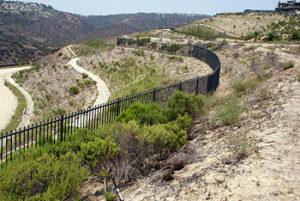
Establishing permanent planting on residential slopes has always been a challenge and in recent years has become more technical in nature. New home developments built on sloping lands often leave homeowners with one or more sections of sloping property. Slopes often continue from one property to another, varying in height, width, soil, and sun exposure.
Some slopes are massive in height exposing a variety of soil types and growing conditions. Top to bottom, slopes are often extreme opposites when it comes to soil, soil moisture, and irrigation. Irrigation and rain water travels downward through soil and accumulates at the foot of the slope-moistest area. The highest parts of a slope, especially those that are south facing and exposed to full sun, are the driest and most difficult to establish . Plant the toughest drought tolerance varieties at the upper portions of the slope and plants with higher water needs that tolerate moist soil conditions at the lower portions of the slope.
It's much easier working with short slightly rising slopes than it is to work on steep expansive slopes. If you are planning to do your own planting and soil improvement work, you will need professional advice and some labor. Slopes are steeper than you think, tough to work on, and dangerous. Instead of clawing your way up the mate horn, consider working with a professional designer or experienced contractor. Either way, there are a variety of methods for improving soil and growing plants on sloping land.
PLANTS & PLANTING METHODS
Plants must be compatible with the soil, climate, and moisture available to the plant. Soil improvement with amendment helps plants survive the transplant period to their new home but does not correct a poor choice. Considerable thought must also be given to the placement and location of plants. For example, corner lots with front yard and side slopes adjacent to streets. On suburban neighborhood streets a common form of traffic are cars entering and exiting home driveways. A clear unobstructed view of traffic signs from automobiles must be allowed as well as clear passage for pedestrian traffic. Use shorter shrubs and keep trees well back of corners and street signs.
Depending upon the size of the slope there are several ways to grow vegetation on that bare soil. For getting quick growth to protect a slope or open land from erosion hydro-seeding hydraulically applies seeds to the soil. The seeds are pre-mixed in an organically based light weight solution. The solution is designed to provide a moist environment for quick seed germination. the product is normally mixed in a large truck mounted hopper. A pressurized hose applies the product over a large area. This type of application is especially useful when seasonal rainfall is expected. Hydro-seeded plants are usually annuals and perennial so seeds germinate quickly. Seed mixtures consist of native and non-native flowering plants and shrubs. Native shrubs included in seed mixtures are normally evergreen plants and take much longer to establish than wildflowers. On a residential property, seeds are normally watered with overhead spray irrigation until they germinate. Custom seed mixes are also available to suit a particular climate or site requirement.
Certain wildflower plants can actually improve soil fertility while doing their job to reduce soil erosion. Once they have bloomed and are spent you can allow these plants to regenerate from their own seeds or install the permanent landscape plants. When properly maintained, and allowed to regenerate, hydro-seeded natural wild flowers will last for years. Normally, hydro-seeding residential slopes is not a long term solution for planting but will buy you some time before you install permanent container plants which at a much greater expense.
Installing container grown plants when landscaping your slope is the fastest way to get the job done. It is also the most costly solution. There are several advantages to using container plants; planting from containers is permanent, slope coverage is immediate, plants will establish more quickly, less care and maintenance than hydro-seeded areas. Landscaping multiple slopes on a residential property often requires the help of a landscape designer or landscape contractor. Designing permanent planting for a slope addresses screening from wind and neighboring views along with the particular site issues mentioned earlier.
In general evergreen drought tolerant shrubs are desirable for planting on slopes because of their longevity and low maintenance. On tall slopes behind homes, locating most trees and shrubs within the central portion of the slope is a good idea for several reasons; helps reduce the overall height of tall slopes that tend to dwarf yards below, shrub and tree density screens neighboring views into yard, less plants and maintenance needed for upper slope, and allows for a wider variety of plant choices.
Certain trees and shrubs are more suited to life on sloping terrain than are others. As a general rule evergreen trees with a narrow upright cylindrical canopy or narrow vase shape canopy are best suited for slope planting. These trees provide good screening in stands or groups, withstand tough wind, and allow sunlight to plants below. Dense canopied, or "lollypop" form trees, and tree types that develop surface roots are not recommended. This type of tree becomes top heavy as it matures often blowing in strong winds.
Trees and plants look best when several plants of one species are planted together, in stands, or massed. This creates large swaths of texture and color. Repeat this with several types of plants that contrast and compliment one another and that have similar care and watering needs. It's OK to experiment, but resist the urge to plant 'one of these and one of those' creating a fruit salad of confusing mish mash, and a maintenance nightmare.
Mulching & Maintenance
Proper maintenance is most critical the first year after planting. Weed infestations unchecked in new plantings especially on slopes are expensive and time consuming to eradicate and dispose. Beautiful jobs can easily be ruined by the lack of weed control. Weeds grow quickly and compete with plants for space and sun. Weeds deplete the soil of nutrients and moisture. A pre-emergent applied after planting and prior to mulching kills weed seeds and greatly reduces weed growth. Combine your attack on weeds with manual removal and light chemical application of round-up if necessary. It is important to protect your investment with weekly weed removal.
Mulching provides a layer of natural decomposed organic matter over the top of the soil after planting. There are different types of mulching materials available. Specifically, organic mulches, are easily available, inexpensive, and easy to apply. Organic mulch consists of a composted green waste, normally shredded branch material. Organic mulches are also available in redwood or cedar, but quite more expensive to obtain. Mulch controls weed growth by blocking out sun to seeds. It also controls the soil temperature and moisture which provides better growing conditions and reduces water use. Apply a 2"-4" thick layer of mulch evenly over the top of the soil. Keep the mulch away from the base and stems of plants. Apply light mist of water to reduce dust and wash off plants. Mulching is by far one of the best garden investments you can make.